manufacturing, service and
Professional manufacturer
Service hotline
400-0531-567

manufacturing, service and
Professional manufacturer
Service hotline
400-0531-567

Add: No. 818, Jingshi Road, Jinan, China
Tel: 0086-531-87453566
Fax: 0086-531-87453566
P.C.: 250306
Homepage: http://www.sdjk.org.cn
Mailbox sdjkgroup@163.com
jianke3566@163.com
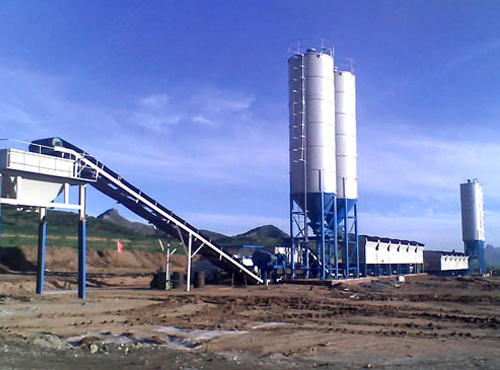
A concrete mixing plant is composed of systems such as feeding, storage, batching, discharging, and control, as well as structural components. The use of a concrete mixing plant for centralized mixing of cement concrete has the following advantages:
(1) Centralized mixing of cement concrete is beneficial for strictly controlling the concrete mix proportion, ensuring the quality of concrete, and fundamentally changing the inaccurate situation of dispersed mixing and batching on site;
(2) Centralized mixing of cement concrete is conducive to the use of automation technology, which can significantly improve labor productivity, save labor, and reduce costs;
(3) Adopting centralized mixing method, installing mixing equipment at the construction site, stacking sand and gravel materials, and storing cement, thus saving space and avoiding waste of raw materials.
(4) Concrete mixing machines can be divided into self falling and forced types according to their types. The self falling mixing drum can have a large capacity and is suitable for mixing large particle sizes.
(5) Strong mixers are divided into two types: vertical shaft and horizontal shaft. The high-pressure concrete mixer has good quality and is suitable for mixing low slump, dry hard concrete.
The concrete mixing plant is the core of engineering construction, and its equipment condition, maintenance, personnel allocation, division of labor and cooperation directly affect the production efficiency and quality reliability of the project. Therefore, formulating effective management measures for mixing plants is the key to ensuring project quality, improving project efficiency, and achieving quality goals.
Common faults in concrete mixing plants:
The air conveying system is the execution device of the concrete mixing plant. Its function is to switch to each aggregate bin, mixer discharge door, cement weighing discharge door in a timely manner according to the instructions issued by the industrial microcomputer, break the arch of the cement in the cement bin, blow and mix the additives to ensure accurate measurement of various aggregates, cement, and additives, and complete the loading task of finished materials. As long as it is used and maintained correctly, the system can ensure efficient and economical production of the entire machine.
The common faults are as follows:
1. Cause of malfunction
Air source failures mainly occur in air compressors, pressure reducing valves, pipelines, compressed air processing components, etc.
The common faults of air compressors are damaged check valves, severely worn piston rings, damaged intake valve plates, and clogged air filters.
After the air compressor stops automatically for more than ten seconds, turn off the power and move the large belt pulley with a hand disc. If it can easily rotate once, it means that the check valve is not damaged, otherwise it is damaged; It can also be judged based on the exhaust volume of the exhaust port under the automatic pressure switch. If the air compressor stops automatically and continues to exhaust until it restarts, it indicates that the check valve is damaged and needs to be replaced. The slow increase in pressure of the air compressor accompanied by oil leakage indicates that the piston ring of the air compressor is severely worn and should be replaced in a timely manner. At the same time, when the inlet valve plate is damaged or the air filter is clogged, it will also cause the pressure of the air compressor to rise slowly (but without oil leakage). Place your palm on the air intake of the air filter. If hot air flows out from the top, it indicates that the intake valve is damaged and needs to be replaced; If the suction is small, it is usually due to the air filter being dirty, and the filter needs to be cleaned or replaced.
2. The pressure reducing valve has failed. The pressure is not high, often due to the breakage of the pressure spring or the rupture of the diaphragm, which must be replaced; The pressure is slow and the filter screen is usually clogged. It should be removed and cleaned.
3. Pipeline facilities malfunction. When there is a leak or hose rupture at the joint, the location of the leak can be determined based on the sound. If the condensed water in the pipeline is prone to freezing and blocking the gas path, it should be promptly eliminated.
4. Failure of compressed air treatment device. The filter element of the oil and water separator is blocked or damaged, and the moving parts of the drain valve are not flexible. Regularly clean the filter element to remove oil and other impurities from the drain valve. The nozzle does not drip oil, and there is water accumulation at the bottom of the oil cup.
Address: No. 818, Jingshi Road, Jinan, China
Tel: 0086-531-87453566
Fax: 0086-531-87453566
Postal Code: 250306
Email: sdjkgroup@163.com
jianke3566@163.com