
manufacturing, service and
Professional manufacturer
Service hotline
400-0531-567

manufacturing, service and
Professional manufacturer
Service hotline
400-0531-567

Add: No. 818, Jingshi Road, Jinan, China
Tel: 0086-531-87453566
Fax: 0086-531-87453566
P.C.: 250306
Homepage: http://www.sdjk.org.cn
Mailbox sdjkgroup@163.com
jianke3566@163.com
The concrete mixer was originally invented by the British, so it is speculated that the concrete mixer was also invented by the British.
Its appearance period was in the form of self falling mixing. Forced mixing equipment emerged with the increasing demand for concrete. Forced mixers can be divided into two types: horizontal axis and vertical axis. Almost all households have these two types of mixers.
The self falling mixer can be traced back to the early 20th century. Drum concrete mixing equipment driven by steam engines emerged in the early 20th century. In the following 50 years, the double cone mixer and split drum mixer, as well as the flip discharge type and flip discharge type, have emerged and developed successively.
The self dumping concrete mixer is mainly used to mix plastic concrete, therefore, the forced concrete mixer has emerged. Since its rise in the early 1950s, forced mixing technology has rapidly developed and been promoted. The first to appear was the disc type vertical axis forced concrete mixer. This mixer is divided into two types: propeller type and planetary type.
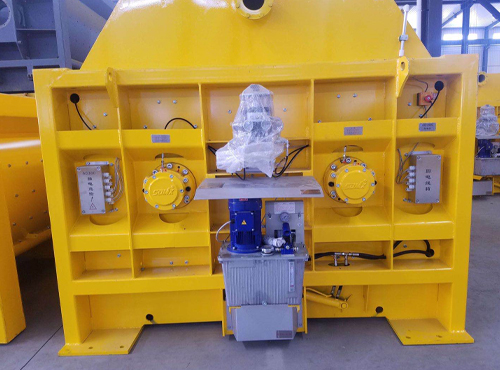
After the 1970s, with the application of lightweight aggregates, horizontal shaft circular groove forced mixers, also known as horizontal shaft mixers, emerged. It is divided into two types: single horizontal axis and double horizontal axis, and has both self falling and forced stirring characteristics. A new type of mixer developed in the 1970s, which can be divided into single axis and double axis types. This mixer has both self lowering and forced mixing functions. The linear velocity of the mixing blades is smaller than that of the vortex type, so the wear resistance is lower than that of the vortex type. The single horizontal axis mixer is made in Germany, with a compact structure, low power consumption, wear-resistant blade lining, full load starting, and the ability to mix lightweight concrete. Our country also introduced the prototype to the company. The double horizontal axis mixer is a new type of equipment developed with the improvement of concrete construction technology. Since the late 1940s, foreign countries have emerged in the United States and Germany, but due to the immaturity of shaft end sealing technology, its development has basically stagnated.
In the early 1970s, due to technological breakthroughs, double horizontal shaft mixers were redeveloped to the right in many countries and have now formed a series of products. In the early 1980s, China successfully developed it, but the development speed was very fast, far exceeding other models in terms of product specifications and quantity. The core of a double horizontal axis mixer is the stirring mechanism, which has good working performance, high productivity, and high maintenance costs. The mixer consists of a horizontally placed double groove companion cylinder, two mixing shafts rotating in opposite directions, and mixing blades mounted on them. The action radii of the stirring blades intersect with each other, and the blades form a certain angle with the axis. When the stirring shaft rotates, the blades drive the stirring shaft, causing the mixture on the stirring shaft to move in a circular motion between the two stirring shafts, rolling up and down. At the overlapping part of the stirring blades, the mixture overlaps between the two shafts, and at the same time, it continuously moves from the rotation plane to the other rotation plane along the stirring shaft direction. Compared with the self falling soil mixer, this mixing method has a stronger effect and is mainly suitable for mixing dry and hard concrete.
Subsequently, continuous concrete mixers emerged. Its working principle is: equipped with spiral mixing blades, each material is continuously weighed according to the ratio and sent to the mixer, and the mixed concrete is continuously discharged from the discharge end. The advantages of continuous soil mixer are short mixing time and high production efficiency.
With the development of concrete materials and construction techniques, many new types of concrete mixers have emerged, such as steam heated mixers, supercritical speed mixers, sonic mixers, swing disc mixers without mixing blades, and secondary mixing concrete mixers.
Address: No. 818, Jingshi Road, Jinan, China
Tel: 0086-531-87453566
Fax: 0086-531-87453566
Postal Code: 250306
Email: sdjkgroup@163.com
jianke3566@163.com